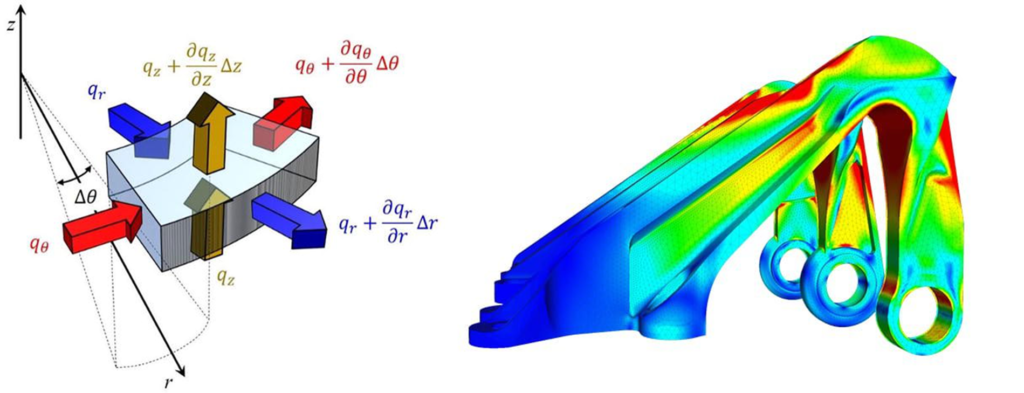
Numerical/CFD Analysis: solving complex engineering problems, predicting system behavior, and optimizing designs where analytical solutions are impractical or impossible
Domain Discretization & Mesh Generation: To work out complex systems, we break down a continuous physical domain (such as the geometry of a mechanical part, fluid flow region, or thermal field) into smaller, finite parts, typically referred to as elements or cells. This discretization is essential for converting the continuous governing equations (e.g., partial differential equations, PDEs) into algebraic equations that can be solved numerically.
Governing Equations: The governing equations form the mathematical foundation for analyzing mechanical systems. They are derived from fundamental physical principles and describe the behavior of the system in terms of field variables (such as velocity, pressure, temperature, and displacement) over time and space. For mechanical systems, equations may be simplified using linear assumptions (e.g., small deformations) or advanced to handle nonlinearities like large deformations or material plasticity.
Boundary and Initial Conditions: The governing equations alone are insufficient; boundary conditions (e.g., no-slip, symmetry, or periodic boundaries) and initial conditions must be applied to fully define the problem
Verification and Validation: Verification and Validation of numerical simulations is carried out rigorously by our teams to confirm that the numerical models are both mathematically correct (verification) and physically accurate (validation). V&V are critical for reducing errors, improving confidence in simulation results, and ensuring that the numerical models accurately represent real-world behavior